The Anglican Indigenous Network (AIN) has met in person for the first time since 2019 at St Peter’s Cathedral, Adelaide and elected a new Chair of the network.
The meeting from September 4 to 7 served to further the existing dialogues around how the worldwide Church can support Indigenous Peoples and how First Nations People can also contribute to the life of the Church with their unique gifts and knowledge.
During the course of the meeting, there was also a special service to honour the ministry of the Rt Revd Chris McLeod, Assistant Bishop of Adelaide, who has contributed greatly to the work of the AIN, as he concludes his role as the National Aboriginal Bishop in the Anglican Church of Australia.
The meeting of the Anglican Indigenous Network
The AIN was founded in 1992 to help give voice in the Anglican Church to Indigenous Peoples who are minorities in their ancestral lands. The network exists to affirm the shared spirituality, concerns, gifts and hopes of Indigenous Anglicans, alongside a commitment to bring Indigenous leadership and vision more fully into the life of the Church.
AIN delegates represent Indigenous communities within Anglican provinces, such as Aotearoa, the United States, Hawai‘i, Canada, Australia and the Torres Strait Islands. In recent months, significant developments for Indigenous Anglicans in Australia have given renewed importance to the gathering.
The Anglican Church of Australia’s General Synod made the decision this year to fund full-time National Aboriginal and National Torres Strait Islander Bishops. These two roles will serve as Assistant Bishops to the Primate. The decision is a milestone in the history of the Church’s witness of commitment to collaboration and reparation between the Anglican Church and First Nations People.
The decision came after consultation with the National Aboriginal and Torres Strait Islander Anglican Council (NATSIAC) to elevate First Nations leadership within the church. NATSIAC members met in the lead-up to the AIN meeting and spoke during the meeting.
Discussions on the challenges and opportunities facing First Nations People in the Anglican Church
Despite the diversity of countries, cultures and ecclesial structures represented around the table, Indigenous Anglican leaders identified similarities in the challenges confronting their communities.
The Rt Revd Susan Wallace, Bishop of Te Waipounamu in Te Pīhopatanga o Te Waipounamu, the first Māori woman bishop in the Anglican Church, shared perspectives on the evolution of Te Pīhopatanga o Aotearoa (the Māori Anglican Church). She reflected on the journey of Tikanga Māori (Māori customs and processes), from the constitutional promise of Te Pouhere (the 1992 commitment by the Anglican Church in Aotearoa, New Zealand and Polynesia to operate as an equal partnership of three distinct cultural streams) and the vision of Te Oranga Ake (human flourishing), through to the assent to Bill 15 at General Synod, which placed the administration of funds from St John’s College Trust Board with the Māori Church.
‘From an Indigenous perspective, we have to test ourselves when we have resources. Something great is coming and the answer exists in our Indigenous knowledge,’ said Bishop Susan.
Levi Torrey, a Dean-in-training in Te Hui Amorangi ki Te Upoko o Te Ika, spoke about the flourishing youth ministry within his Hui Amorangi (episcopal unit), while also highlighting the challenge of sustaining and expanding that work as its sole youth worker.
The Most Revd Chris Harper, National Indigenous Anglican Archbishop of Canada, spoke about a season of renewal and the work of Sacred Circle, a national gathering of Indigenous Anglicans for prayer, worship, discernment and decision-making. He highlighted the Sacred Circle Covenant, presented to General Synod in 2023, which articulates the relationship between Sacred Circle, Indigenous ministries and the wider Anglican Church of Canada.
Archbishop Chris Harper also reflected on The Covenant and Our Way of Life, a document expressing who Indigenous Anglicans are and how they understand their place within the Church, including their right to shape ecclesial life according to their own contexts, cultures and languages. He also acknowledged the continuing tensions Indigenous Anglicans encounter within inherited colonial and liturgical structures.
Underlying these conversations was a common aspiration to move Indigenous Anglican communities beyond survival towards flourishing, while offering their gifts to the wider Anglican Communion.
Delegates also elected Archbishop Chris Harper as the new Chair of the network and spoke about strengthening Indigenous leadership, creating safe pathways for young people into faith and ministry, exercising greater authority over resources and drawing upon Indigenous knowledge to shape the future of the Church.
Despite the challenges many report in terms of resources, shortages of Indigenous clergy and ministry workers and insufficient representation within Church decision-making, time was also spent emphasising the distinctive gifts Indigenous peoples bring to the Church through relationships with land and water, storytelling, song, spirituality and community. These considerations were understood not simply as cultural contributions, but as sources of theological insight capable of enriching the life and mission of the wider province.
Uncle Ray Minniecon of Scarred Tree Ministries in Sydney closed the meeting with a reflection on Psalm 116:12, the same verse posed by the Revd Richard Johnson in the first Christian sermon to Australian settlers: ‘What shall I render unto the Lord for all his benefits toward me?’
Uncle Ray suggested that, for Indigenous peoples, perhaps the response might now be found in the verses that follow: ‘I will take the cup of salvation and call upon the name of the Lord.’
A service honouring Bishop Chris McLeod’s ministry as National Aboriginal Bishop
A service was held on 5 September to celebrate the ministry and service of Bishop Chris McLeod, National Aboriginal Bishop in the Anglican Church of Australia. The service marked the conclusion of Bishop Chris’ time in this role and he received a carved walking stick to accompany him on his onward journey. Several of the members of the Anglican Indigenous Network, of which Bishop Chris has been an important part, were also present at the service.
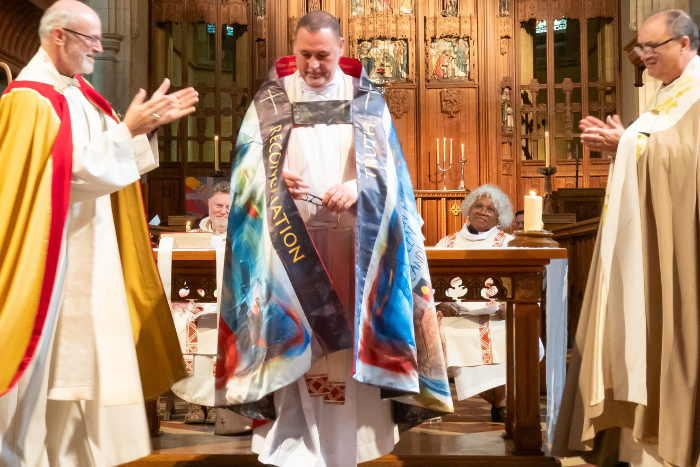
From left: the Most Revd Dr Ric Thorpe, Archbishop of Melbourne; the Rt Revd Chris McLeod, wearing the ‘Stolen Generation Cope’; and the Rt Revd Dr Mark Short, Primate of the Anglican Church of Australia, at the service honouring Bishop McLeod’s ministry as National Aboriginal Bishop on 5 September 2026.
The service also involved the presentation of the ‘Stolen Generation Cope’ to the National Aboriginal and Torres Strait Islander Anglican Council (NATSAC), a gift from the Archbishop of Canterbury, the Most Revd and Rt Hon Dame Sarah Mullally, accompanied by a letter from her. This was presented by the Most Revd Dr Ric Thorpe, Archbishop of Melbourne, and blessed by the Primate of the Anglican Church of Australia, the Rt Revd Dr Mark Short. The cope is a clerical garment by artist Terry Duffy and was created as a living, liturgical symbol honouring the First Nations Peoples of Australia. The full letter can be found on the Archbishop of Canterbury website.
The Most Revd Ric Thorpe, Archbishop of Melbourne, shared via social media that he felt ‘honoured’ to present the cope to the Indigenous Anglican Church and First Nations communities, on behalf of the Archbishop of Canterbury. ‘It is more than a liturgical vestment: it is an act of witness, memory and moral reckoning. It seeks to open hearts and minds, challenge silence, and remain an enduring catalyst for Truth, Reconciliation and Justice.’
Martha Jarvis, Special Representative to the United Nations on behalf of the Anglican Communion and link director for the Anglican Indigenous Network, was present at the meeting of the Anglican Indigenous Network and the service celebrating Bishop Chris. Martha shared that she felt ‘honoured to observe the Anglican Indigenous Network meeting and to be at the presentation of the cope. Both were signs of grace in indigenous Anglicans' long journey of pursuing truth, justice and reconciliation. I pray their histories and hopes are more widely understood across our Communion and beyond, that we might walk ahead together as Jesus leads.’
More information
Find out more about the mission of the Anglican Indigenous Network.
Learn about the Sacred Circle in Canada and Scarred Tree ministries in Australia.
See the full letter from the Archbishop of Canterbury accompanying the cope.
See a social media post from the Archbishop of Melbourne.
See examples of Terry Duffy’s other sacred vestment artwork, including the Coventry Dresden cope (a memorial of the destruction of Coventry Cathedral and Dresden in World War II).