More than 100 Anglicans with ecumenical guests from around the world undertook a pilgrimage on 1 July through the historic city of Derry/Londonderry. The pilgrimage was part of ACC-19 (the 19th meeting of the Anglican Consultative Council). It is being hosted by the Church of Ireland in Belfast (28 June to 4 July 2026).
The international delegation is made up of bishops, clergy and laity from 38 Anglican provinces worldwide. Among them was the Archbishop of Canterbury (the Most Revd and Rt Hon Dame Sarah Mullally), the Secretary General of the Anglican Communion (the Rt Revd Anthony Poggo), the Chair of the ACC (Canon Maggie Swinson); and the Vice-Chair (the Most Revd Hosam Naoum, Archbishop in Jerusalem).
Together, Archbishops Sarah and Hosam recently undertook a joint pilgrimage of prayer and solidarity in the Holy Land, after which they shared a pastoral letter.
Welcomed by the Bishop of Derry and Raphoe
The pilgrimage was organised by the Right Revd Andrew Forster, Bishop of the Diocese of Derry and Raphoe, with members of the local church and community. Through prayer, reflection and encounters with the city’s history, the delegation explored the Church of Derry’s ministry in the midst of sectarian conflict and Northern Ireland’s peace process. It was an opportunity to draw lessons for a global church serving communities in conflict around the world, including South Sudan, Sudan, the Middle East, Myanmar and the Democratic Republic of Congo.
Peace is a fragile thing that must be handled with care
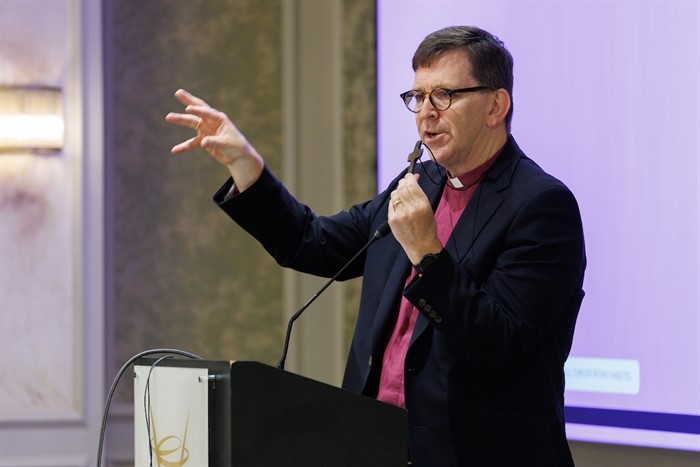
The Rt Revd Andrew Forster, Bishop of Derry and Raphoe, welcomes the Most Revd and Rt Hon Dame Sarah Mullally DBE, Archbishop of Canterbury, as she arrives for the ACC-19 pilgrimage visit to Derry/Londonderry. Photo: Neil Turner
Greeted by Bishop Andrew, the pilgrimage began at Ebrington Square. A former British military complex for over 160 years, Ebrington was closed and handed to the public in 2003 and has since been transformed into a vibrant shared civic and cultural space.
Setting the scene for the day, Bishop Andrew expressed his hope that the pilgrimage would be an opportunity to ‘journey further into the heart of God, journey further into the heart of other people’s experiences, and journey further into our own discipleship and journey of faith.’ Of the delicate work of peacebuilding in the city, he added: ‘Peace is always a fragile thing that must be handled with care — the more care we use, the more we value it and see it as precious.’
Anglicans walk over The Peace Bridge
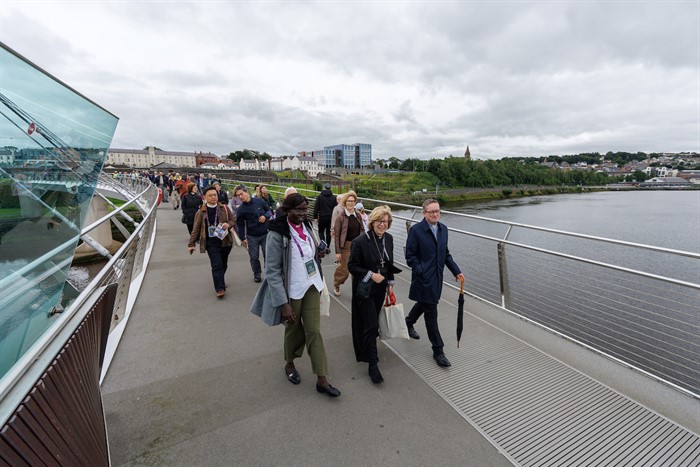
The Most Revd and Rt Hon Dame Sarah Mullally DBE, Archbishop of Canterbury, ACC members and local volunteers cross the Peace Bridge during the pilgrimage visit to Derry/Londonderry. Photo: Neil Turner
From Ebrington, the group walked across the Peace Bridge, which opened in June 2011, supported by the European Regional Development Fund. The ACC-19 pilgrims crossed the River Foyle on foot to reach the city’s historic walled centre. The 235-metre footbridge links the largely Nationalist Cityside with the largely Loyalist Waterside, and has become one of Northern Ireland’s most powerful symbols of reconciliation. As they crossed, Bishop Andrew encouraged the group to ‘think about how we can build bridges in our own context’ — words that resonated deeply with delegates from some of the world’s most conflict-affected regions.
Greeted by local dignitaries at the Guildhall
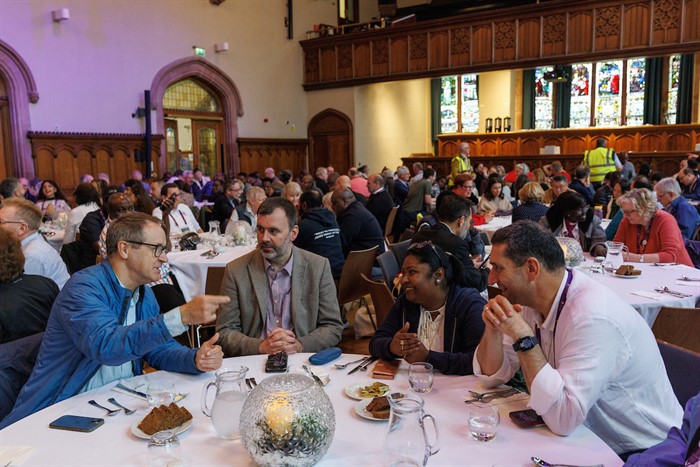
ACC members gather for lunch at the Guildhall during the pilgrimage visit to Derry/Londonderry. Photo: Neil Turner
The pilgrims arrived at the Guildhall for lunch, where they received greetings from Ian Crowe MBE CSJ, the Lord-Lieutenant for the County Borough of Derry/Londonderry, and Cllr Grace Uí Nialláis, the newly elected Mayor of Derry City and Strabane District Council. Built between 1887 and 1890, the city’s neo-Gothic civic centrepiece was bombed during the Troubles, yet later served as the seat of the Bloody Sunday Inquiry, also known as the Saville Inquiry (2000–2005), which led to the UK Government’s formal acknowledgement that the killing of civilians in 1972 was unjustified.
Walking the Walls to St Augustine's
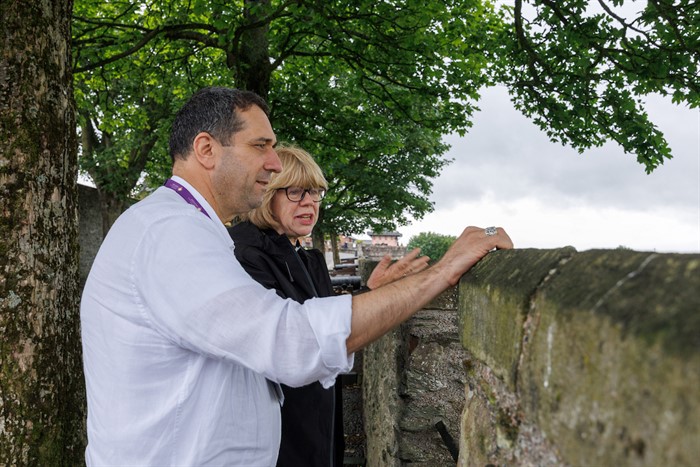
The Most Revd and Rt Hon Dame Sarah Mullally DBE, Archbishop of Canterbury, and the Most Revd Dr Hosam Naoum, Primate of the Episcopal Church in Jerusalem and the Middle East and Vice-chair of the Anglican Consultative Council, look out from the City Walls towards Creggan and Brandywell during the pilgrimage visit to Derry/Londonderry. Photo: Neil Turner
After lunch, the pilgrimage continued along the ancient city walls — themselves dating back to the early 17th century — to St Augustine’s Church, known locally as ‘The Wee Church on the Walls’. The route brought the group past sites associated with some of the most intense violence of the Troubles, providing a sobering backdrop to the conversations that followed.
The Archbishop of Canterbury and the Archbishop of Jerusalem were part of the pilgrimage. The pair have recently completed a joint pilgrimage in the Holy Land, where they prayed with churches and communities impacted by conflict. In Derry, they looked over the walls, which give a clear view of the Bogside and Free Derry Corner. The area was a frequent flashpoint during the troubles and it was there, on 30 January 1972 that the tragic events of Blood Sunday occurred.
At St Augustine’s, the delegation was received by the Revd Nigel Cairns, Rector of Templemore and St Augustine’s and Dean of Derry, and heard presentations on the Church of Ireland’s peace and reconciliation ministry and its practical community development work, including climate resilience and energy grant programmes.
Richard Moore - A Story of Forgiveness
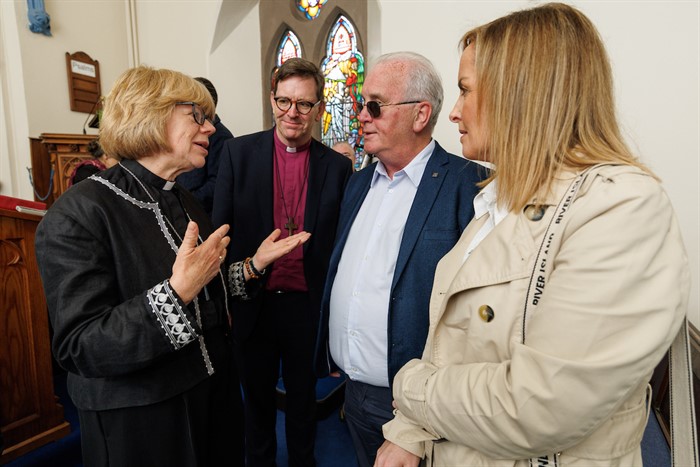
The Most Revd and Rt Hon Dame Sarah Mullally DBE, Archbishop of Canterbury, meets Richard Moore at St Augustine’s Church, known as the ‘Wee Church on the Walls’, during the pilgrimage visit to Derry/Londonderry. Photo: Neil Turner
A highlight of the day came at St Augustine’s Church, where the delegation heard from Richard Moore, a Derry resident who was blinded aged ten in 1972 when he was struck by a rubber bullet fired by a British soldier called Charles Innes during the Troubles. More than thirty years later, Richard sought out and met the soldier responsible — an act of courage and grace that he described with honesty and humour.
Reflecting on his initial hesitation, Richard recalled: ‘The man had hurt me, my mammy and daddy — he was a British soldier. Was I letting my own side down and other victims? But I wanted to meet him.’
His account of that encounter and of his own journey toward forgiveness moved the international congregation deeply. Speaking of the importance of striving for reconciliation, he said: ‘No matter how difficult the situation might seem, given the right level of support, love and compassion, you can contribute to the lives of other people and you can overcome the difficulties that you face and use them in a positive way. I believe that if you really want reconciliation, it has to begin within yourself. Forget everyone else. Begin in your own heart. Not Stormont. Not Westminster. Not with politicians. If you can reconcile your own heart, you can reach out to others.’
At St Columb’s Cathedral for the closing service
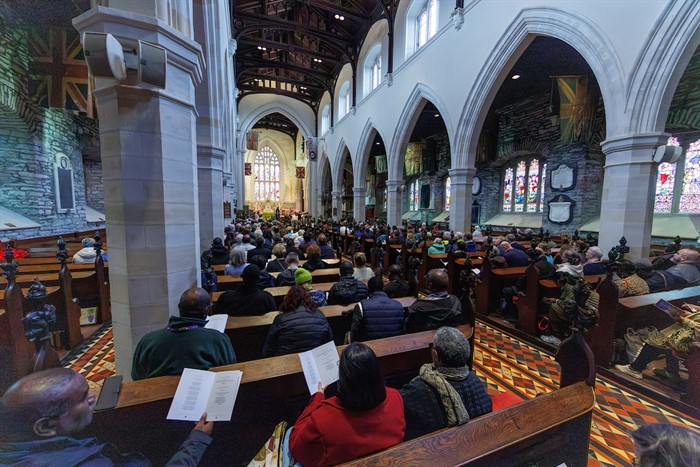
ACC members gather for worship at St Columb’s Cathedral during the pilgrimage visit to Derry/Londonderry. Photo: Neil Turner
The pilgrimage concluded at St Columb’s Cathedral, reached through the city walls and past further sites associated with Bloody Sunday. Consecrated in 1633, St Columb’s is both Derry/Londonderry’s oldest surviving building and the first Anglican cathedral built in Britain or Ireland after the Reformation. Named after St Columba, who founded a Christian settlement on the site in the sixth century, it has stood through siege, conflict and the Troubles as a place of enduring faith. Here, the themes of the day — history, suffering, forgiveness and hope — were brought before God in a service of prayer and reflection.
The Archbishop of Canterbury thanks the Church of Derry/Londonderry
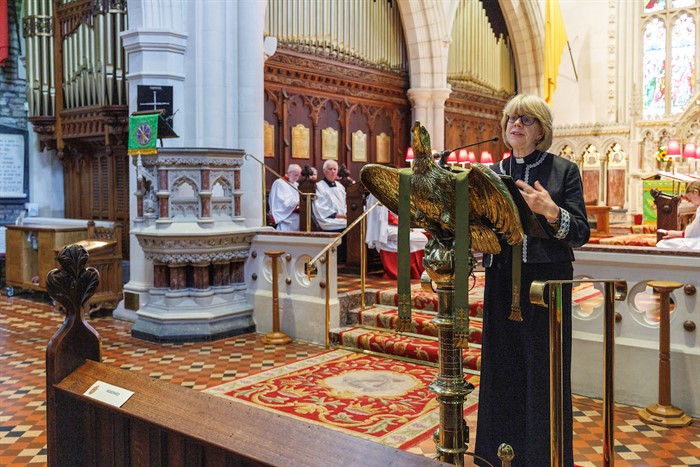
The Most Revd and Rt Hon Dame Sarah Mullally DBE, Archbishop of Canterbury, speaks during a service at St Columb’s Cathedral as part of the ACC-19 pilgrimage visit to Derry/Londonderry. Photo: Neil Turner
Addressing the congregation at the closing service, the Archbishop of Canterbury reflected on the pilgrimage through the city and its significance to the Anglican visitors gathered from across the world saying: ‘As the Anglican Consultative Council, we represent our provinces across the Anglican Communion, many of which have within their midst conflict, a need for reconciliation and for peace. And it has been very significant for us to walk here today, to listen to the story of peace and reconciliation in Derry. For us to talk to each other about our own story. And it has been a reminder to me how peace, reconciliation and forgiveness starts with us. Our prayers are very much with you in Derry and we are grateful for you to pray for us in our journey of reconciliation, forgiveness and peace. Thank you for your hospitality and the peace that you have shared with us.’
Reconciliation ministry cannot airbrush the past
ACC-19’s pilgrimage to Derry/Londonderry was an important day in the weeklong programme, providing delegates with time to consider situations of conflict from around the world.
Words by The Very Reverend Nigel Cairns written in the foreword of the Order of Service, offered poignant and deep challenge to conclude the day: ‘…reconciliation is not a ministry of forgetting, not a ministry of silence, not a ministry of denial or even a ministry of airbrushing the past. Reconciliation calls people everywhere to become (just like Richard), more than our fears, more than our injuries and more than our inherited divisions. It insists that every person is viewed as being made in the image of God.’
The ACC-19 programme concludes in Belfast on Saturday 4 July.