For World Refugee Day 2026, the Anglican Communion has released a statement resisting divisive political narratives as global displacement nears 136 million.
The statement released ahead of World Refugee Day (June 20) invites ‘people of goodwill to stand alongside refugees in prayer, advocacy, friendship and action’.
The statement has been written by the Most Revd Maimbo Mndolwa, Archbishop of Tanzania and the Rt Revd Mark Edington of the Convocation of Episcopal Churches in Europe, who are representatives of the Anglican Communion on the United Nations High Commissioner for Refugees Multi-Religious Council of Leaders.
This is the third statement regarding the treatment and status of refugees and other displaced groups within the last 12 months.
Anglican Communion resists divisive political narratives as global displacement nears 136 million
Statement issued on 16 June
For World Refugee Day (20 June, 2026), we are writing together both to celebrate and to resist. We celebrate the dignity of refugees and displaced persons, and the contributions they make in our faith communities. We celebrate the lives saved over 75 years of action under the global Convention on Refugees. In agreeing to that convention, nations of the world came together in a shared response and with a common voice, seeing the vulnerability of people forced to flee their homes as a concern to all humanity. We celebrate that the Convention has enabled dialogue among nations on significant topics like national identity, the availability of resources and efficiency of international systems for response, assistance and repatriation.
But we write as well to resist—to resist increasingly powerful narratives that polarise how we see refugees and how we speak of them, often reducing them to slogans to gather votes.
This is the third statement we have made in under a year. The number of refugees now is greater than it was when we spoke at the UN’s Global Refugee Forum Progress Review just six months ago—and their treatment in receiving countries, most of which are developing, is increasingly uncertain. UNHCR anticipates that 136 million people will be forcibly displaced by the end of 2026; and many of these, especially children, will be stateless. We write to resist the status quo creating this chaos, defined by violence, othering and a transactional regard for human life – a status quo foreign to the Kingdom of God and the love Christ teaches his disciples.
In our walk as Christian leaders, we believe we are all foreigners in this world to some degree. Millions across our worldwide Anglican Communion are currently displaced, have been displaced, or have family members fleeing their homes. These sisters and brothers in Christ embody the spiritual reality of us all. How we define our own identities this side of heaven needs to allow space for love of the other, the stranger and the enemy. Whatever our political convictions, that love will have a practical outworking in welcoming refugees and will serve as a witness against the degradation of refugees’ humanity and dignity.
The global reach of the Anglican Communion means that Anglican churches accompany displaced people across borders and along many of the major routes travelled by refugees and migrants. Churches, along with other faith communities and people of goodwill, receive and serve refugees when they come to places of safety, shelter and asylum. In Europe, churches within the Anglican Communion and their partners have developed programs to welcome and support refugees, reaching around 300,000 people since Russia’s invasion of Ukraine. In Egypt, the Anglican Church has created the humanitarian organisation Refuge Egypt, which works closely with UNHCR to provide refugees with essential items, medical support, education, livelihood development, spiritual guidance and encouragement. This builds the self-sufficiency and self-respect refugees need for repatriation, resettlement or local integration into Egyptian society. Refuge Egypt often serves the most vulnerable and stigmatised – women and children fleeing violence, who would not otherwise receive relief, healing and work.
These are just two examples. Today, the Anglican Communion is in ongoing dialogue with UNHCR to identify ways to collaborate and to strengthen the coherence and effectiveness of our response.
We write today as well with a challenge. We challenge ourselves and all Anglicans, in all parts of the world, about how we can make our global collective response better by working across lines of geography and culture. At the forthcoming meeting of the Anglican Consultative Council (28 June – 4 July), Anglicans from around the world will engage in consultations on how we can deepen the coherence, visibility, and quality of our response to forced displacement. We invite our brothers and sisters at ACC to prioritise concrete measures that will help reduce the pressures that lead people to flee their homes, and increase the welcome they receive when they find places of safety.
We also challenge world leaders to have the courage to engage in dialogue—with each other, and also with faith communities—about our shared responsibilities. How we respond to the most vulnerable is a test of our integrity and courage—and, indeed, of our very humanity. Public discourse about refugees must not be driven by fear, exclusion, or political expediency. It must call us to work together in the shared interest of all of humanity, and to do so in pursuit of justice, peace, human dignity and sustainability, especially for the most vulnerable. And as we do so, refugees themselves must remain central agents in shaping their own futures.
This is what the 1951 Refugee Convention set out to do. The need for both vision and action is far more urgent today. We urge world leaders to engage constructively with UNHCR to ensure the Convention does so for another 75 years. We honour the extraordinary courage shown daily by refugees and displaced people: the courage to survive conflict and loss, to undertake dangerous journeys, to rebuild and to continue hoping amid uncertainty. And we give thanks for the quiet, faithful work of thousands of Anglicans in churches around the world who strive each day to treat refugees with compassion, dignity and understanding.
On this World Refugee Day, we invite Anglican churches and all people of goodwill to stand alongside refugees in prayer, advocacy, friendship and action. Now is the time to stand together to resist divisive narratives.
This statement is shared by the Anglican Communion's representatives on the UNHCR Multi-Religious Council of Leaders:
The Most Reverend Maimbo Mndowla, Archbishop and Primate, the Anglican Church of Tanzania.
The Right Reverend Mark D. W. Edington, Bishop in Charge, the Convocation of Episcopal Churches in Europe (TEC).
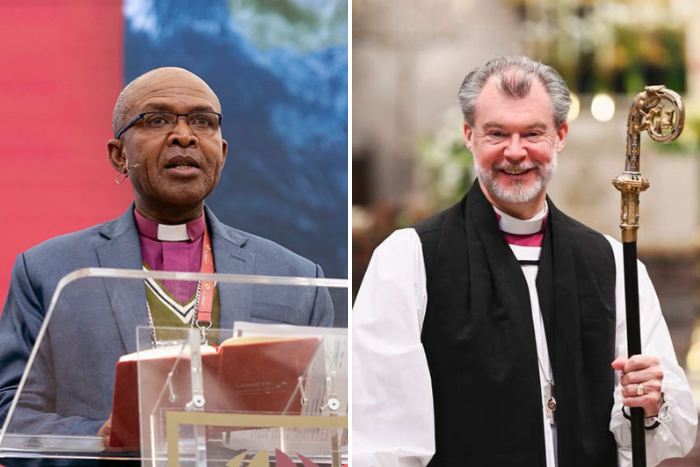
The Most Revd Maimbo Mndolwa, Archbishop and Primate of Tanzania (left) and the Rt Revd Mark Edington, Bishop of the Convocation of Episcopal Churches in Europe (right)
More information
See articles about the previous joint statements from Archbishop Maimbo and Bishop Mark – Anglican representatives on the Mult-Religious Council of Leaders to the UNHCR from December 2025 and March 2026.
Find out more about the UN High Commissioner for Refugees.